Table of Content
Short version: the tool is lawful to use. Whether your download is legal comes down to two things the internet loves to confuse, and neither of them is the software.
Summary It depends on the use, not the tool Using FDOWN.net is not a crime. What you download and what you do next is where the law actually looks. Downloading your own uploads is clearly fine. Saving a public video to watch offline on your own device sits in the low-risk lane. Reposting, selling, or grabbing private content without consent is where genuine legal exposure begins. Framework based on standard copyright principles, Facebook's Terms of Use, and the four-factor fair use test under Section 107. |
If you have ever tried to save a Facebook video, you have met the same wall millions hit every month. Facebook hides the download button on purpose, so people reach for a tool like FDOWN.net. The question that follows is fair and surprisingly slippery: am I actually allowed to do this?
The honest answer is that legality has almost nothing to do with FDOWN.net itself, and almost everything to do with the video you point it at. To make that click, you only need to separate two rulebooks that usually get blended into one.
The one idea that unlocks this whole topic Two separate rulebooks are in play. One is Facebook's Terms of Use, which is a private contract between you and a company. The other is copyright law, which is actual law. They carry very different weight, and once you can tell them apart, the grey turns into clear lanes. |
The Tool
FDOWN.net Is Not the Part That Decides Legality
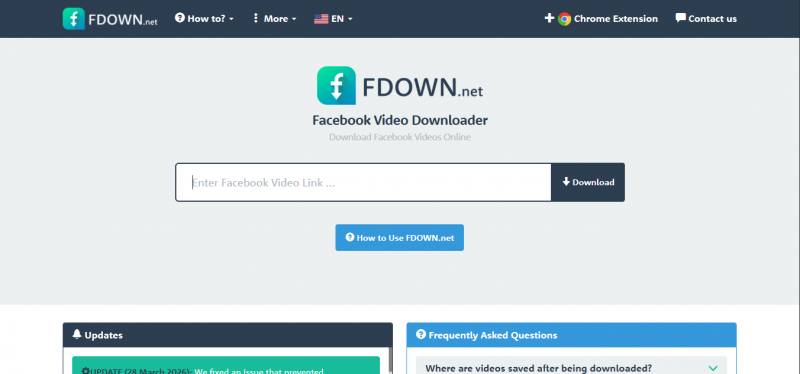
FDOWN.net is a single-page web downloader. You paste a Facebook video link, it finds the underlying file on Facebook's own content delivery network, and it hands you an MP4. It does not host videos, it does not re-encode them, and for public clips it never asks you to log in to Facebook.
That last detail matters more than it looks. A tool that never signs in as you is not tied to your Facebook account, so running it is a lawful act on its own. The legal weight sits entirely with the content and the use. In other words, the same tool can be perfectly fine for one video and a problem for the next, and nothing about the software changes between those two clicks.
| 0 / 92 | 88 | 20+ |
| Antivirus flags | Trust score | Years domain age |
Safety figures reported in the independent review linked below.
Safe and legal are different questions On the safety side, FDOWN.net scans clean across 92 antivirus engines and carries a two-decade domain history, which our full FDOWN.net safety review breaks down in detail. That answers whether the site will harm your device. This guide answers a separate question, which is whether the download is allowed. A tool can be safe to run and still be pointed at content you have no right to take. |
Two Rulebooks
Terms of Use Versus Copyright Law
Almost every argument about downloading Facebook videos is really two arguments wearing one coat. Pulling them apart is the fastest way to know where you stand.
Rulebook one: Facebook's Terms of Use
Facebook asks users not to collect content through automated means without permission. A third-party downloader falls outside what the platform designed for, so using one can put you offside with the terms. But a terms agreement is a contract, not criminal law. The realistic worst case is an account matter, such as a warning or restriction, rather than a courtroom. A browser tool that never logs in as you also touches nothing linked to your account.
Weight: account risk, not legal risk
Rulebook two: copyright law
Copyright exists automatically the moment an original video is recorded. No symbol and no registration are needed. The person who filmed and uploaded it owns it, and Facebook only holds a license to host and show it. Downloading makes a copy. Whether that copy is fine depends entirely on what happens next. This is the rulebook with real teeth, and it is the one worth paying attention to.
Weight: the real legal question
| Question | Terms of Use | Copyright law |
|---|---|---|
| What is it | A private contract with a company | Actual law that protects creators |
| Who enforces it | Facebook, through your account | The copyright owner, through legal channels |
| Typical consequence | Warning, feature limit, or suspension | Takedown, civil claim, or damages |
| Applies to a browser tool that never logs in | Weakly, since nothing is tied to your account | Fully, because a copy is still a copy |
| Triggered by | The method of collecting content | What you do with the content afterward |
Map
The Legality Spectrum, From Clearly Fine to Clearly Not
Because the use decides everything, the clearest way to see your position is to place your scenario on a line. On the left you are on solid ground. On the right you are exposed. Most everyday downloads live comfortably at the green end.
| Scenario | What it means | Standing |
|---|---|---|
| Your own uploads | You hold the copyright, so keeping a backup is your right | Clearly legal |
| Public video, watched offline by you | Not republished, not sold, not claimed as yours | Low risk |
| Public video, privately sent to one friend | A small step past personal use, rarely an issue in practice | Grey area |
| Reuploading or posting it elsewhere | You are redistributing work you do not own | Infringement |
| Using it in a monetized project | Commercial use of another creator's video without a license | Infringement |
| Private or group video without consent | Breaks the terms and raises privacy and copyright exposure | High risk |
The Matrix
The Same Scenarios, Scored Against Both Rulebooks
If you prefer the picture side by side, here is every common case checked against copyright, the terms, and the risk you would realistically face.
| Scenario | Copyright | Terms of Use | Real-world risk |
|---|---|---|---|
| Download a video you uploaded | You own it | Native option exists | None |
| Save a public clip to watch offline | Copy for personal use | Outside the terms | Low |
| Send a saved public clip to a friend | Minor redistribution | Outside the terms | Grey |
| Repost a creator's video as your own | Infringes copyright | Breaks the terms | High |
| Use a clip in a paid or branded project | Commercial infringement | Breaks the terms | High |
| Grab a private video you were not given | Infringes and invades privacy | Clearly breaks the terms | Severe |
A useful mental shortcut
The question is never whether you pressed download. It is what you do with the copy. Watching privately is the calm end. Publishing, profiting, or taking content that was never shared with you is where the law starts to care.
Fair Use
Does Fair Use Quietly Make It All Fine?
Fair use is the doctrine people reach for when they want a download to be legal. It is real, it is written into Section 107 of the US Copyright Act, and courts weigh four factors to decide whether an unlicensed use qualifies. It is worth knowing what those factors actually reward.
| Factor | What a court asks | Favors you when |
|---|---|---|
| Purpose and character | Is the use commercial, or does it add new meaning | The use is nonprofit, educational, or transformative |
| Nature of the work | Is the original factual or creative | The source is factual rather than artistic |
| Amount used | How much of the work you took | You use a small, necessary portion |
| Market effect | Does your use harm the creator's market | Your use does not compete with the original |
Here is the part that surprises people. Fair use leans toward commentary, criticism, news, teaching, research, and work that transforms the original into something new. Downloading a whole video to enjoy privately is not really a fair use argument at all. It tends to be safe for a different reason, which is that it is invisible and almost never litigated. Feeling safe and being legally protected are not the same thing, and it helps to know which one you are relying on.
The honest caveat Fair use is decided case by case, and only a court can rule on it with certainty. Treat it as a defense for genuine commentary or education, not as a blanket permission slip for saving whatever you like. |
Stakes here
What Actually Happens If You Cross a Line
The consequences scale with the harm, and most of them never reach a courtroom. Knowing the ladder helps you judge how much any given download is really worth.
| What you did | Most likely consequence | Severity |
|---|---|---|
| Broke only the terms, using a browser tool | Account warning or feature limits, if traced at all | Minor |
| Kept a private copy of a public video | Practically nothing, though not formally licensed | Minimal |
| Reuploaded or redistributed a video | Takedown notice, a strike, or a possible civil claim | Moderate |
| Used a clip commercially without a license | Civil damages and a formal legal demand | Serious |
| Distributed content widely and knowingly | Higher civil damages, with criminal exposure in extreme cases | Severe |
The Green Lane
The Clearly Safe Way to Use It
If you want to skip the grey entirely, four kinds of download stay firmly in the clear. Stick to these and the legal question mostly answers itself.
Download with confidence when it is
- Your own content. Videos and livestreams you posted, which you already own outright
- Public, for your eyes. A public clip kept on your device to watch offline, not shared or sold
- Permission in hand. Anything where the creator clearly told you that saving it is fine
- Native downloads. Content Facebook itself offers a built-in download button for
For your own material specifically, Facebook's own Download Your Information tool hands you the originals with no third party involved at all. It is slower, but it is the cleanest path there is.
The 20-Second Check
Three Questions That Settle Almost Any Case
Before you paste a link, run it through these in order. If all three land on the calm answer, you are almost certainly fine.
- Question 1
Whose video is it?
Yours: download freely. Someone else's: ownership stays with them, so keep reading.
- Question 2
Public or private?
Public: the file is already an open address. Private: you need clear consent first.
- Question 3
What will you do with it?
Watch it yourself: low risk. Publish or profit: you need a license.
Bottom LineSo, is it legal? FDOWN.net is a lawful tool, and using it is not a crime. Legality is decided by the content you choose and what you do with the copy, never by the software in the middle. Your own uploads and personal offline copies of public videos live in the safe lane. Reposting, monetizing, or taking private content without consent is where real legal risk begins. Low risk for your own and public content, used privately. High risk the moment you republish someone else's work. |
Post Comment
Share your thoughts about this article.
Be the first to post a comment!