THE SHORT ANSWER PolyAI is built for large, call-heavy enterprises, not small businesses. There is no free tier, no self-serve signup, and no price listed on the site. Independent estimates put annual contracts in the six figures, often cited near $150,000 a year before usage. If you run a small business with modest call volume, PolyAI will almost certainly be more capability, and more cost, than you need. If you field hundreds of thousands of calls a year and quality and compliance cannot slip, the math can flip in its favor. |
A NOTE ON WHERE THESE NUMBERS COME FROM I went straight to PolyAI's official pricing page at poly.ai/pricing to find real figures, and like a lot of people, I left without a single dollar amount. The page describes how pricing works and what every plan includes, but it publishes no rates, no tiers, and no minimum spend. So every number in this article that looks like a price is drawn from third-party estimates and independent reviews. Read them as informed ranges, not official quotes, and confirm current pricing with PolyAI before you make any decision. |
PolyAI pricing by the numbers
391% Forrester-cited three-year ROI, from a study PolyAI commissioned | ~$150K Estimated starting annual contract, per third-party reviews | ~95¢ Estimated cost per minute of handled call time | 37 Total public reviews across G2, Gartner and Trustpilot |
Figures are third-party estimates and independent data, not official PolyAI quotes.
What the page tells you
What PolyAI's own page says
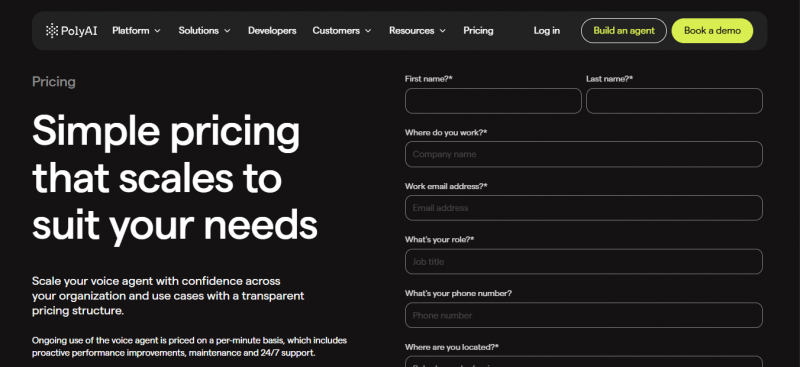
PolyAI prices ongoing use of its voice agent on a per-minute basis. That per-minute rate is described as covering proactive performance improvements, maintenance, and around-the-clock support, so the meter and the service that keeps it running are bundled together.
Every plan is said to include the same core: a web ticket portal plus a 24/7 emergency support phone line, strong data security with compliance certificates and regular audits, a 99.9% uptime guarantee on your phone lines, ongoing monitoring, feature upgrades, and a tech stack that keeps evolving. On paper, that is a genuinely enterprise-grade package.
What you will not find anywhere on the page is a number. There is no rate card, no starter tier, and no self-service checkout. To get an actual price, you request a demo and go through a sales conversation. That single fact tells you a lot about who the product is designed for.
Per-minute billing means the meter counts the full length of each handled call, including processing time and pauses, not only the seconds a customer is speaking.
What it really costs
The numbers, according to third-party estimates
Because PolyAI keeps prices behind a sales call, the public picture comes from reviewers, competitors, and analysts who have seen or modeled real contracts. Two patterns show up again and again: a six-figure annual floor, and per-minute usage billed on top of it.
Independent estimates in US dollars unless noted, not official PolyAI rates
| What reviewers estimate | Figure | Source |
|---|---|---|
| Entry level, monthly | around 5,000 /mo | Callin |
| Mid tier, monthly | 10,000 to 20,000 /mo | Callin |
| Enterprise, monthly | 30,000+ /mo | Callin |
| Typical annual contract floor | around 150,000 /yr | CloudTalk, GetVocal, Synthflow |
| Estimated per-minute rate | around 95 cents /min | Marlie |
| European first-year spend | reported above 200,000 EUR | GetVocal |
The through-line is consistency, not precision. Different sources land on different monthly figures, but almost all of them agree that PolyAI starts in six-figure territory once you annualize it, and that there is a minimum commitment. That floor is the real story for a small business, because a low-volume team still has to pay for capacity it may never use.
One widely cited illustration comes from a review that modeled a company spending about $256,000 a year on PolyAI and estimated a net benefit above $540,000 in the first year, driven by higher automation and retained revenue. It is a useful picture of the scale PolyAI is engineered for, though it comes from a review rather than PolyAI itself, so treat it as directional rather than a promise.
Beyond the sticker price
The costs that sit on top of the contract
The headline contract is rarely the whole bill. Independent write-ups flag several extras a buyer should budget for before signing anything.
| Add-on cost | What to expect |
|---|---|
| Telephony carrier fees | Usually separate from PolyAI and tied to your existing phone provider and call routing |
| CRM integration setup | Connecting to Salesforce, Genesys, or custom systems can take internal engineering time |
| Compliance work | In regulated industries this adds real cost and can grow larger than teams expect |
| Volume spikes | Per-minute billing means an outage or seasonal rush can produce a bill your forecast never planned for |
None of these are unusual for enterprise software, but together they widen the gap between the quoted contract and the true cost of ownership. For a small business watching every line item, that unpredictability is often a bigger problem than the headline rate.
Is PolyAI affordable for a small business?
The most useful way to answer this is to look at fit rather than price alone. PolyAI is not badly priced for what it is. It is simply priced for a different buyer. Here is a quick way to tell which side of the line you fall on.
When it can make sense
▪ You handle very high call volume, in the hundreds of thousands of calls a year
▪ Call quality and compliance cannot slip, as in banking, insurance, healthcare, or telecom
▪ You have a six-figure budget and want a fully managed, hands-off deployment
▪ You have no in-house conversational AI engineers and want the vendor to run everything
When it probably does not
▪ Your call volume is modest, seasonal, or still growing
▪ You want to see a real price before you talk to a salesperson
▪ You need to launch this month, not after a multi-week sales cycle
▪ Flat, predictable monthly costs matter more to you than enterprise polish
For most small businesses, the honest answer is that PolyAI is not an affordable fit. The technology is strong and the outcomes are real, but the six-figure floor means a smaller company ends up paying for capacity it will not use. That is not a knock on the product. It is a mismatch of scale.
How the price compares
PolyAI vs cheaper voice AI alternatives
The clearest way to see PolyAI's position is to line its estimated per-minute rate up against the platforms small businesses usually shortlist. Adoption is climbing fast: AI voice agents handled about 14% of inbound small-business calls in late 2025 by one industry estimate, up from roughly 2% a year earlier, so more small teams are weighing exactly this decision. Most of those alternatives publish prices openly, start at a few cents per minute, and let you sign up without ever talking to sales. Here is how the starting rates line up.
Starting per-minute rate, representative 2026 figures
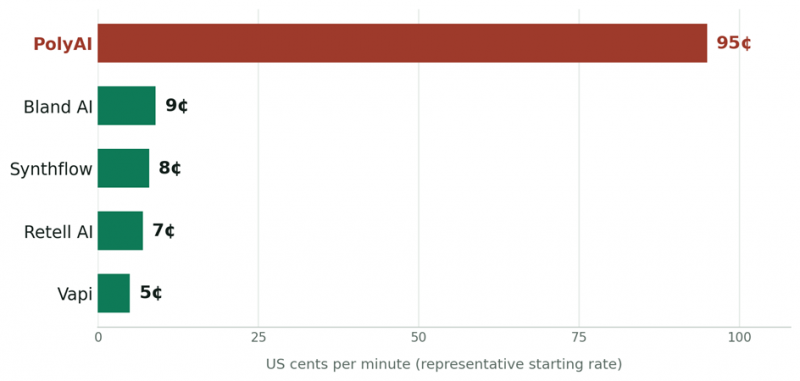
Representative starting rates from vendor pages and independent 2026 roundups, in US cents per minute. Real all-in costs vary with language model, voice, and telephony, and can run several times higher. PolyAI also carries an estimated six-figure annual minimum that the others do not.
The bar chart only tells half the story, because a per-minute rate means little without the commitment behind it. PolyAI pairs its rate with an estimated $150,000 a year floor, while several alternatives start on month-to-month plans in the tens of dollars. For context, independent write-ups put even the enterprise annual contracts of developer platforms in the $40,000 to $70,000 range, still well below PolyAI's estimated starting point.
Representative 2026 pricing from vendor pages and independent roundups, not official quotes
| Platform | Starting rate | Entry commitment | Free trial | Best fit |
|---|---|---|---|---|
| PolyAI | around 95¢ /min | around $150,000 /yr floor | No | Very high volume enterprises |
| Vapi | from 5¢ /min | free minutes, then usage | Yes | Developer custom builds |
| Retell AI | from 7¢ /min | pay as you go | Limited | Quality and low latency |
| Synthflow | from 8¢ /min | from $29 /mo | Yes | No code SMB teams |
| Bland AI | from 9¢ /min | from $299 /mo | No | High volume outbound |
| CloudTalk | flat monthly plans | published per seat | Yes | SMB phone system |
A fair warning on all of these figures: most come from the vendors themselves or from comparison pages selling an alternative, and the gap between an advertised per-minute rate and a real invoice can run three to six times higher once language model, voice, and telephony costs are added. Verify current pricing directly before you commit. The pattern still holds, though. If predictable, published pricing matters to you, the market gives small businesses real choices that PolyAI was never built to serve.
What buyers say about the price
PolyAI pricing reviews, in buyers' own words
PolyAI sells to a small number of large enterprises, so its public review pool is thin. Across G2, Gartner Peer Insights, and Trustpilot there are only about 37 reviews in total, and pricing comes up in very few of them, so read the sentiment below as directional rather than statistically solid.
For the record, the public ratings sit high but on a very small sample: 5.0 on G2 from about 12 reviews, 4.7 on Gartner Peer Insights from 23, and 3.5 on Trustpilot from just 2. That is far too few to read as settled sentiment.
Why buyers say it is worth it
▪ A Forrester Total Economic Impact study commissioned by PolyAI reported a 391% three-year ROI, which enterprise buyers cite to justify the spend

▪ Case studies such as PG&E point to labor hours saved, including during outage-driven call surges
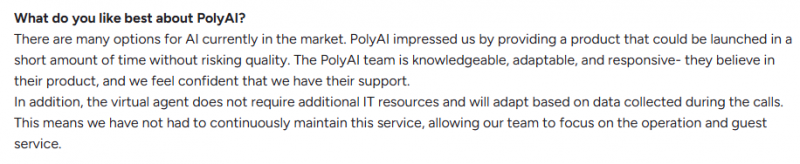
▪ One reviewer reported roughly a 90% cut in operating costs and called the platform transformative
▪ Buyers like that support, maintenance, and optimization are bundled into the per-minute rate rather than billed as extras
Where the price frustrates people
▪ A Gartner reviewer said the overall cost makes some workflows hard to justify, and felt the relationship leaned toward driving volume over improving performance
▪ A user flagged the pricing as too variable and wished for one straightforward price instead of many fluctuating factors

▪ Buyers appreciate the flexible terms but find the pricing hard to forecast without a formal quote

▪ Some Gartner feedback questions whether the total cost is justified for lower-volume or narrower use cases
The split is consistent. Enterprises running stable, high-volume operations tend to feel the price is fair for the outcome, while teams with smaller or spikier call patterns are the ones who find the model hard to justify and hard to predict. That maps almost exactly onto the affordability question for a small business.
Final verdict
Powerful, but priced for the enterprise
Small business affordability 2 / 10 | Enterprise fit and ROI 9 / 10 | Pricing transparency 2 / 10 |
PolyAI is one of the strongest voice AI products on the market, and for a large enterprise fielding huge call volumes the six-figure spend can pay for itself, as the Forrester-cited 391% three-year ROI suggests. The voice quality, the call containment, and the bundled support are the real thing.
For a small business, though, almost everything about the model works against you: no public price, no free trial, an estimated six-figure annual floor, per-minute billing that is hard to forecast, and a sales-led rollout measured in weeks. The capability is real. The affordability, for a small business, is not. If you are small and want AI answering your phones, you will get there faster and cheaper on a transparent per-minute platform, and you can always revisit PolyAI if your call volume ever reaches enterprise scale.
| Bottom line: PolyAI is not affordable for most small businesses, and it was never designed to be. |
Post Comment
Share your thoughts about this article.
Be the first to post a comment!